Engineering Note
Why Kafka Transactions Cannot Commit with Your Database Yet: KIP-939 and 2PC Participation
Learn what Kafka transactions can commit today, why databases and external systems remain outside that boundary, and how KIP-939 proposes to let Kafka participate in externally coordinated 2PC.
Imagine an order service that must save a payment state in its database and publish an event for the delivery service to process.
The database commit succeeds, but Kafka publication fails.
Kafka publication succeeds, but the database commit fails.
If neither outcome is acceptable, a natural question follows: why not put the database in the Kafka transaction?
Today, a Kafka transaction does not solve that problem directly. It can commit multiple Kafka writes and consumer-group offsets as one unit, but an ordinary database transaction or HTTP API call remains outside its boundary. That is why Outbox, Inbox, and idempotency keys still connect the local atomic boundaries of different systems in production.
Kafka has also been exploring a wider boundary. KIP-939 proposes making Kafka a participant in an externally coordinated two-phase commit (2PC). This post separates what you can run with Kafka transactions now from KIP-939, which remains at the proposal and implementation stage.

The Short Answer: What a Kafka Transaction Binds
A Kafka transaction binds the following work into one commit-or-abort unit.
| Work that can be included | Result |
|---|---|
| Records written to several topics or partitions | They all commit, or read_committed consumers see none of them |
| The next offsets of consumed input | They commit with the Kafka output |
| Kafka Streams changelog writes and output | They commit with input processing under exactly_once_v2 |
An ordinary database COMMIT, a payment or notification HTTP call, and a file write are not automatically included in the standard Kafka transaction.
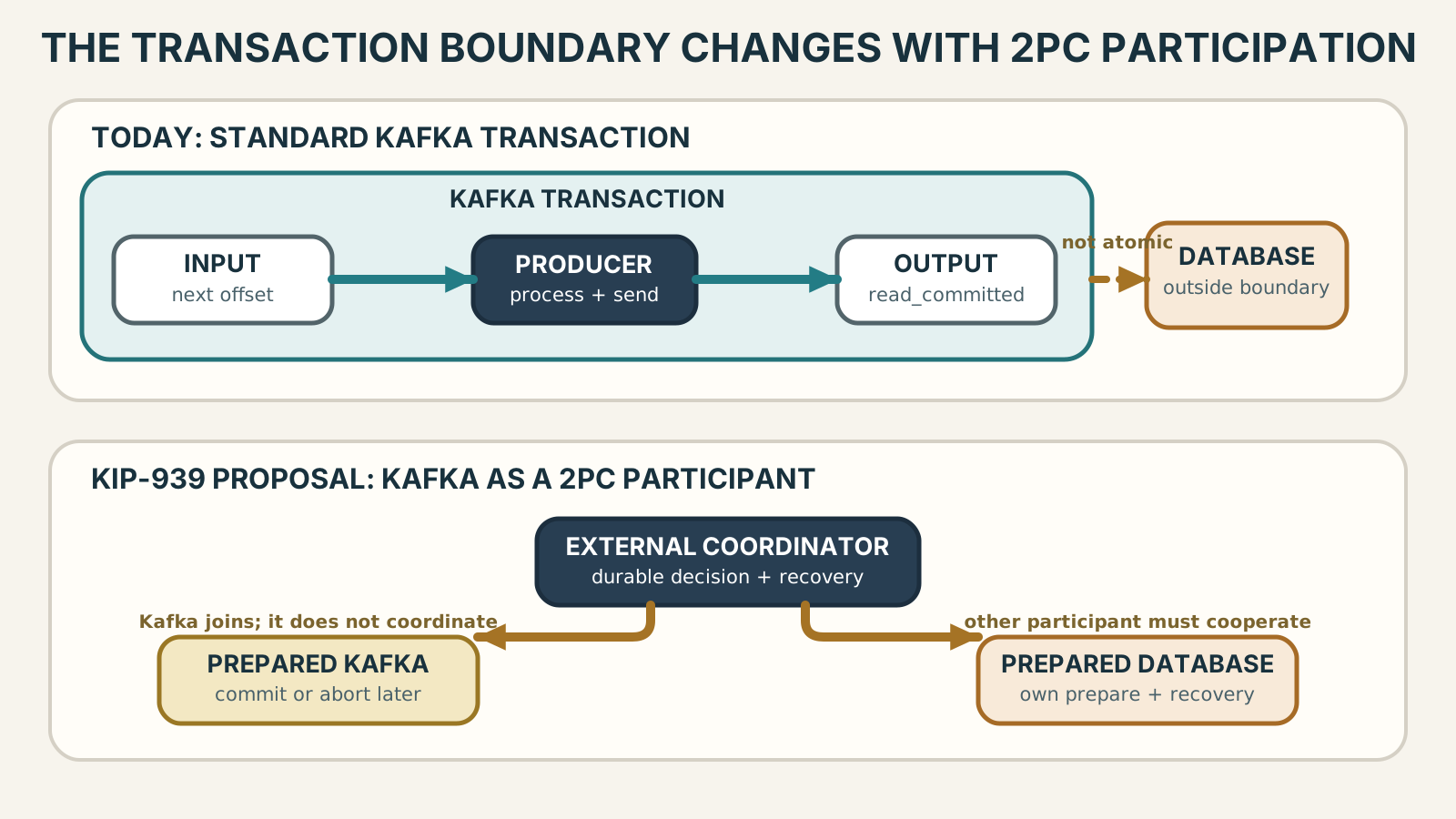
This does not make Kafka transactions weak. They can atomically reflect a path that reads from Kafka, transforms data, and writes back to Kafka. The important part is reading the system boundary precisely enough to choose the right tool.
Common Use 1: Commit Multiple Kafka Writes Together
Suppose an order approval must be recorded in both orders-confirmed and billing-audit. If a record is visible in only one topic, services that consume them can process the same order from inconsistent state.
A producer with a transactional.id can call initTransactions() once, then place its sends between beginTransaction() and commitTransaction().
Properties properties = new Properties();
properties.put(ProducerConfig.BOOTSTRAP_SERVERS_CONFIG, "localhost:9092");
properties.put(ProducerConfig.KEY_SERIALIZER_CLASS_CONFIG, StringSerializer.class.getName());
properties.put(ProducerConfig.VALUE_SERIALIZER_CLASS_CONFIG, StringSerializer.class.getName());
properties.put(ProducerConfig.TRANSACTIONAL_ID_CONFIG, "order-confirmation-0");

try (KafkaProducer<String, String> producer = new KafkaProducer<>(properties)) {
    producer.initTransactions();

    try {
        producer.beginTransaction();
        producer.send(new ProducerRecord<>("orders-confirmed", "order-42", "confirmed"));
        producer.send(new ProducerRecord<>("billing-audit", "order-42", "approved"));
        producer.commitTransaction();
    } catch (ProducerFencedException | OutOfOrderSequenceException | AuthorizationException fatal) {
        producer.close();
        throw fatal;
    } catch (KafkaException abortRequired) {
        producer.abortTransaction();
    }
}
When commitTransaction() succeeds, both topic records commit together. If the transaction aborts, its records may remain physically in the log, but consumers using isolation.level=read_committed do not receive them. That consumer setting is therefore part of the guarantee, not an optional finishing touch.
The KafkaProducer API documentation explains that a transactional producer needs transactional.id, and a newer instance with the same ID can fence the previous one. This is a stable identifier for producer ownership, not a business order ID.
Common Use 2: Make Read, Process, and Write One Unit
In a pipeline that reads Kafka input, transforms it, and writes a different Kafka record, committing the output and input offset separately leaves a failure window.
Output publication succeeds.
The process stops before committing the offset.
The same input is fetched again.
The output can be published again.
sendOffsetsToTransaction(nextOffsets, consumer.groupMetadata()) replaces the consumer’s separate offset commit. It adds the next offset after the consumed records to the current producer transaction, so the Kafka output and consumer position commit or abort together.
This pattern needs auto commit disabled and the consumer configured not to read records from aborted transactions.
Properties consumerProperties = new Properties();
consumerProperties.put(ConsumerConfig.ENABLE_AUTO_COMMIT_CONFIG, false);
consumerProperties.put(ConsumerConfig.ISOLATION_LEVEL_CONFIG, "read_committed");consumer.subscribe(List.of("orders"));
while (running) {
ConsumerRecords<String, String> records = consumer.poll(Duration.ofMillis(500));
if (records.isEmpty()) {
continue;
}
try {
producer.beginTransaction();
for (ConsumerRecord<String, String> record : records) {
String result = transform(record.value());
producer.send(new ProducerRecord<>("order-projections", record.key(), result));
}
// enable.auto.commit=false. Do not separately call commitSync() or commitAsync().
producer.sendOffsetsToTransaction(records.nextOffsets(), consumer.groupMetadata());
producer.commitTransaction();
} catch (ProducerFencedException | OutOfOrderSequenceException | AuthorizationException fatal) {
producer.close();
throw fatal;
} catch (KafkaException abortRequired) {
producer.abortTransaction();
}
}The actor that executes the transaction here is the producer, not the consumer. The producer writes output records and commits the consumer group’s next position on its behalf. That is why this pattern needs enable.auto.commit=false and must not mix in commitSync() or commitAsync().
On abort, the same input can be processed again. What is visible once is the committed combination of Kafka output and offset, not one execution of the processing function. What Does Kafka EOS Actually Guarantee Once? covers that distinction in more detail.
Why the Database and External APIs Remain Outside
The following code looks like one unit, but it contains two independent commits.
database.commit();
producer.commitTransaction();
If the process stops between the two lines, only one can succeed. Reversing the order merely creates the mismatch in the other direction. The standard Kafka transaction coordinator does not know the state of an ordinary database or HTTP server.
That leaves these as the usual choices today:
- Outbox: store the service DB change and the event-to-publish record in one database transaction.
- Inbox: store a consumed
event_idand the business result in one database transaction. - A stable idempotency key and outcome lookup when an external API provides them.
- Business processing that remains meaningful after retries, with compensation when it is needed.
Why Kafka Fits Between Outbox and Inbox explains how to build those contracts at both ends of Kafka. Kafka transactions and Outbox are not competing alternatives; they protect different boundaries.
KIP-939: If Kafka Participates in External 2PC
KIP-939 does not aim to give Kafka XA support or turn Kafka into the coordinator of 2PC. Its goal is to let Kafka become a participant in a 2PC led by an external coordinator. The proposal keeps a Kafka transaction in a prepared state, then lets that coordinator decide whether it finally commits or aborts.
The following is pseudocode for understanding the sequence described in the KIP. prepareTransaction() and completePreparedTransaction() are not APIs you can call from the current public Kafka client, so this is not runnable code.
Begin an external coordinator transaction.
Begin a Kafka transaction.
Produce Kafka records.
Prepare the Kafka transaction.                  ← proposed by KIP-939
Persist DB changes and the prepared decision.
Commit the DB transaction.
Complete the prepared Kafka transaction.        ← decide commit or abort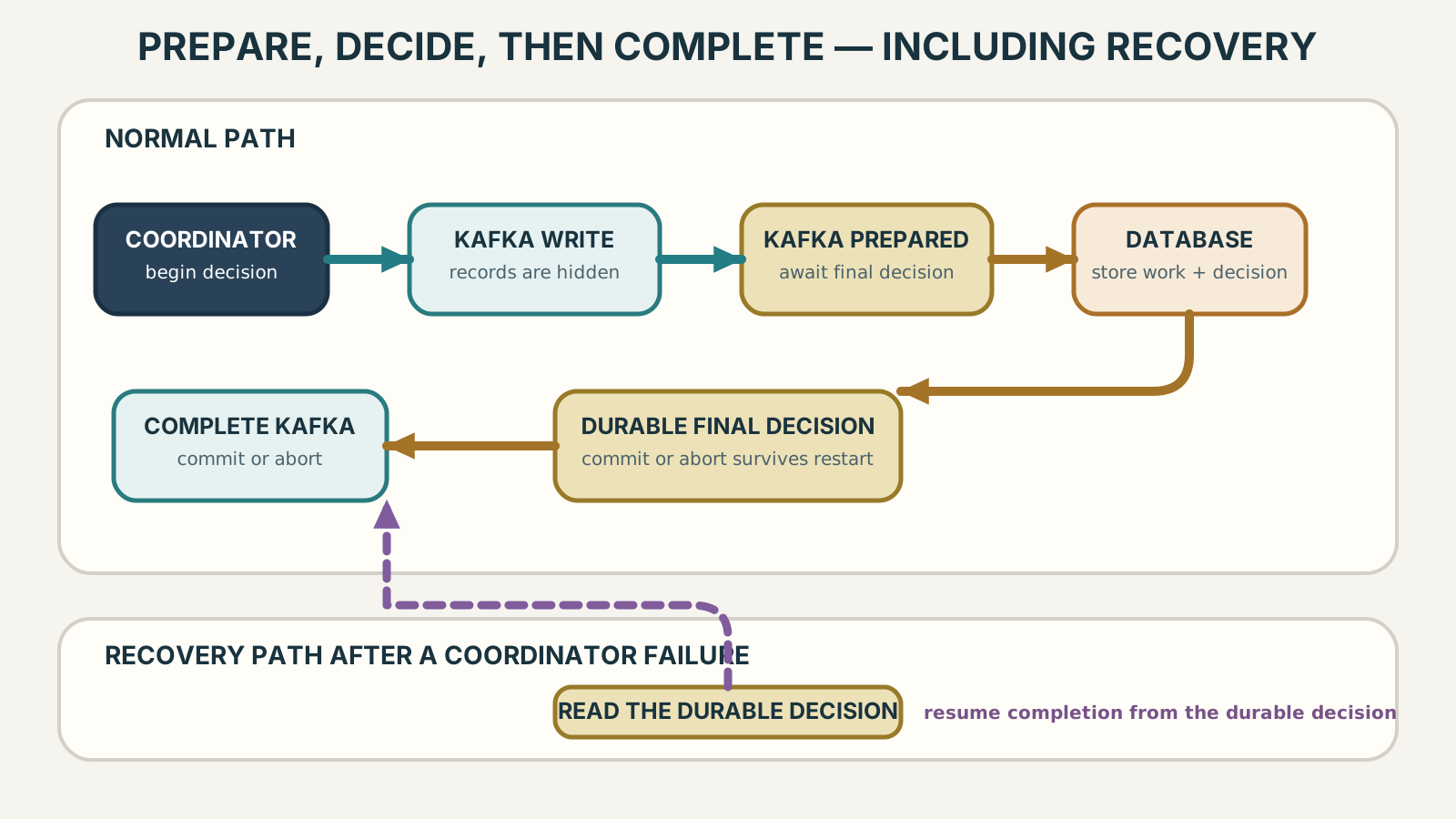
Even if this becomes available, it will not make Kafka and every database automatically one transaction. The system on the other side must also support prepare, commit, and recovery. The external coordinator owns a durable decision record and the retry procedure. KIP-939 proposes Kafka’s participant contract, not a universal distributed-transaction shortcut.
As of 2026-07-21, KIP-939 is Accepted, while its implementation issue KAFKA-15370 is Open. Some subtasks are complete, but prepared-state retention and scenario handling are still in progress. Do not make it a product-design dependency or implement against imagined APIs yet.
The Operational Cost Added by 2PC
Current Kafka transactions time out so Kafka can clean up when a producer disappears. In externally coordinated 2PC, Kafka cannot independently abort only because time passed: that could conflict with the decision made by another participant.
KIP-939 therefore proposes no automatic timeout for a 2PC-participant transaction. The trade-off is that operators must handle transactions that remain prepared for too long.
| When a prepared state stays too long | Operational response needed |
|---|---|
A read_committed consumer can be unable to read later records in that partition | Observe time spent prepared together with consumer delay |
| Log compaction can be unable to advance | Diagnose retention and compaction pressure alongside prepared state |
| A coordinator failure can lose the final decision | Store the decision durably and define a restart procedure |
| A casual force-abort can create inconsistency | Use an authorized administrative procedure with an audit trail |
Kafka needs to be read as an operational system, not only as code concepts such as brokers, topics, partitions, and consumer groups. Konduo connects Kafka-like clustered resources through plugins so teams can inspect status, metric evidence, diagnostics, and alert response in one operating flow. But the final 2PC decision and business recovery rule still belong to the application and its coordinator.
What Should You Choose Today?
| Situation | First tool to choose |
|---|---|
| Results in several Kafka topics or partitions must appear together | Kafka transaction plus read_committed |
| Kafka input is transformed into Kafka output | Include offsets in the Kafka transaction |
| A service DB change and event publication must agree | Outbox and a retryable relay |
| Kafka consumption produces a DB result | Inbox, or atomic storage of result and processing position |
| A payment or notification API is called | Stable idempotency key, outcome lookup, and compensation policy |
| Several systems genuinely support prepare and recovery for 2PC | Check KIP-939 implementation and release status, then evaluate separately |
Kafka transactions are already very useful. Their value is not a promise to bind every system at once; it is precise control over which Kafka results become visible together.
KIP-939 may expand the available choices when it is implemented and released. The most important questions will remain the same.
Who records the final decision?
After a failure, who resumes commit or abort, and on what evidence?
Further Reading
- What Does Kafka EOS Actually Guarantee Once? - Separates producer retry protection, Kafka transactions, and application-level deduplication.
- Why Kafka Fits Between Outbox and Inbox - Explains the dual-write and consumer-duplicate contracts between a database and Kafka.
- Kafka Streams and the EIP Aggregator: Completing Is Harder Than Collecting - Continues the distinction between Kafka processing guarantees and business completion.