Engineering Note
Still Using Redis Only as a Cache? A Practical Look at Redis Streams
A practical look at Redis Streams as an append-only event log with consumer groups, pending messages, acknowledgements, and lightweight event processing.
When people think about Redis, they usually picture GET, SET, TTLs, cache-aside patterns, and maybe distributed locks.
That picture is not wrong. Redis is widely used as a fast key-value store, and it is especially strong as a cache. But if you remember Redis only as a cache, you miss one of its more interesting features.
Redis has Streams.
A stream behaves like an ordered event log. Producers append entries, and consumers read them. That may sound like a queue at first. But Redis Streams also provides consumer groups, pending entries, acknowledgements, and message claiming, which are all important pieces of practical message processing.
So the question changes:
Is Redis only a cache?
Or can it also run a small event pipeline?
This post is a practical answer to the second question.
The short version
- Redis Streams are close to an append-only event log inside Redis.
- Producers add entries with
XADD; consumers read withXREADorXREADGROUP. - Consumer groups let multiple workers divide work from the same stream.
- A message stays pending until it is acknowledged with
XACK. - Pending messages can be inspected and recovered with
XPENDING,XCLAIM, orXAUTOCLAIM. - Streams can be a good fit for small async jobs, internal event processing, and short event histories.
- They are not a universal replacement for Kafka or RabbitMQ.
The key is to stop treating Streams as a small cache side feature.
Redis key-value = fast access to current state
Redis Streams = ordered event flow over time
They live in the same Redis server, but they solve different problems.
What a stream stores
A Redis Stream is a list of entries. Each entry has an ID and a set of field-value pairs.
For example, an order event can look like this:
XADD order-events * orderId 1001 type paid amount 49000The * tells Redis to generate the stream entry ID. The generated ID is usually time-based.
Consumers can read new entries with XREAD.
XREAD BLOCK 5000 STREAMS order-events $From this point of view, a stream is closer to an event log than a simple queue. Entries remain in the stream and can be read by range.
XRANGE order-events - +Redis is still an in-memory system. If a stream keeps growing, memory usage grows too. That means trimming is part of the design.
XTRIM order-events MAXLEN ~ 100000Once you use streams, “how long do we keep events?” becomes an operating question.
How List, Pub/Sub, and Streams differ
Redis already had features that could be used for messaging before Streams. The common ones are Lists and Pub/Sub.
Lists are easy to use as queues.
LPUSH jobs payload
BRPOP jobs 0
They are still useful for simple job queues. But once you need many workers, processing tracking, failed message recovery, and replay-like behavior, much of the design moves into application code.
Pub/Sub is closer to real-time fan-out.
PUBLISH events payload
SUBSCRIBE events
It is lightweight and fast, but messages published while no subscriber is listening are not available later. It is a “deliver to whoever is listening now” model.
Streams provide a different option.
| Feature | List | Pub/Sub | Streams |
|---|---|---|---|
| Message storage | possible | weak | built in |
| Worker distribution | app-managed | per subscriber | consumer groups |
| Completion tracking | app-managed | none | XACK |
| Pending inspection | app-managed | none | pending entries |
| Replay/range reads | limited | none | XRANGE, ID-based reads |
Streams are much more natural when you want a stored event flow inside Redis.
Consumer groups change the model
Consumer groups are the part that makes Redis Streams especially interesting.
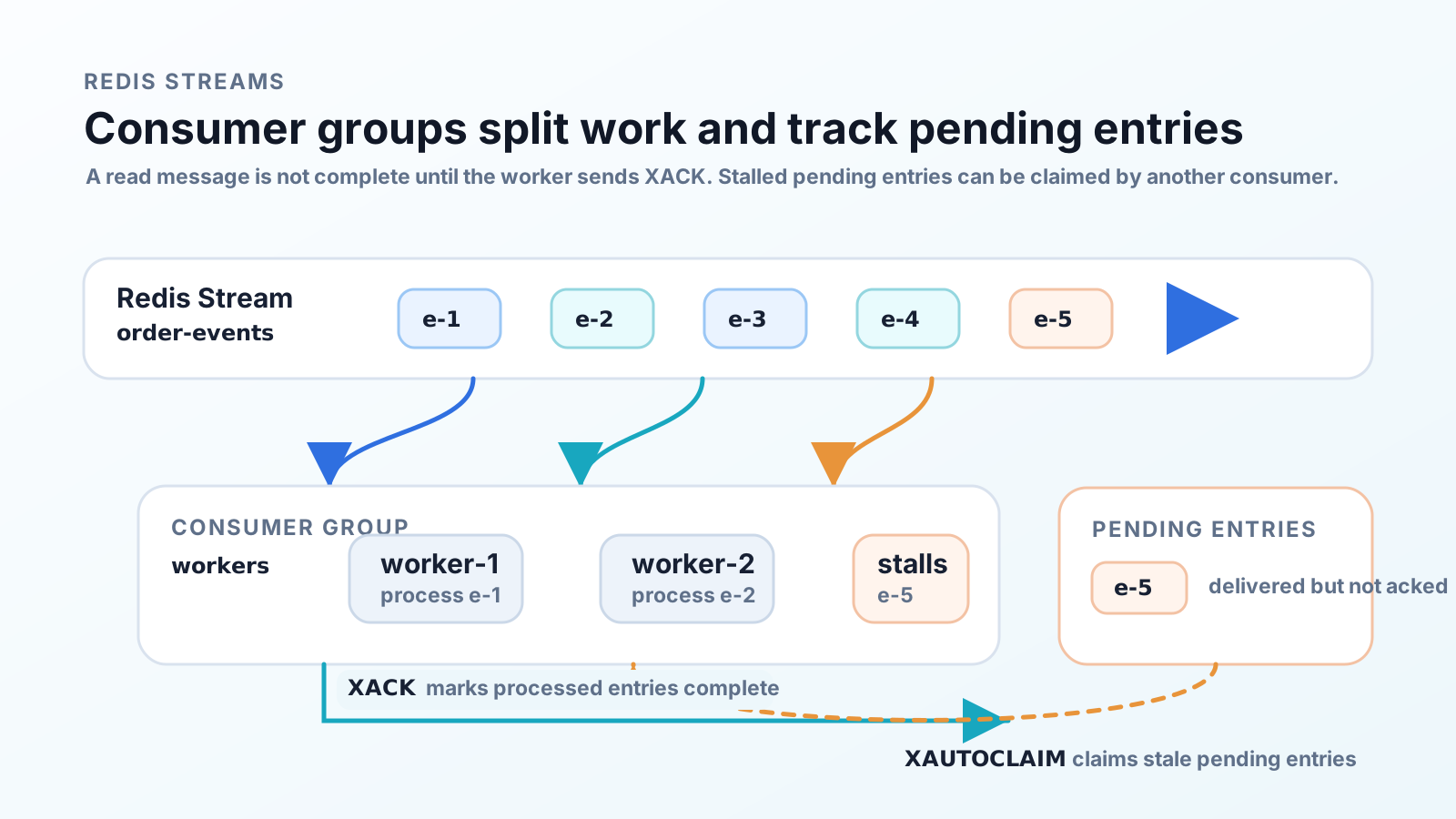
After creating a consumer group, multiple consumers can divide work from the same stream.
XGROUP CREATE order-events workers $Each worker reads with a consumer name inside the group:
XREADGROUP GROUP workers worker-1 COUNT 10 BLOCK 5000 STREAMS order-events >The > means “give me new messages that have not yet been delivered to this group.”
After successful processing, the worker acknowledges the entry:
XACK order-events workers 1718610000000-0The important distinction is that reading and completing are not the same thing.
XREADGROUP delivered the entry
  -> the worker has received it
  -> it has not necessarily processed it successfully

XACK was sent
  -> the entry is considered processed
That gap creates pending entries.
Why pending entries matter
What happens if a worker reads an entry and crashes before sending XACK?
Redis Streams does not immediately forget that message. It remains in the consumer group’s Pending Entries List, usually called the PEL.
You can inspect pending messages:
XPENDING order-events workersYou can also inspect messages held by a specific consumer:
XPENDING order-events workers - + 10 worker-1Messages that have been pending for too long can be claimed by another consumer:
XAUTOCLAIM order-events workers worker-2 60000 0-0 COUNT 10This command finds pending messages that have been idle long enough and transfers ownership to worker-2.
This gives Redis Streams a stronger operating model than “the worker read the message and then it disappeared.”
It does not mean exactly-once processing. Once retries and claiming are involved, the same message may be processed more than once. Handlers should be idempotent.
Think in at-least-once terms.
Tolerate duplicate processing.
Ack only after successful processing.
A small event pipeline example
Imagine an order API that must run several follow-up actions after payment succeeds:
- send a notification
- award points
- update a recommendation model
- record an internal audit event
If the API does all of that inline, request latency grows. With Redis Streams, the request path can append an event and return quickly.
Order API
  -> XADD order-events ...
  -> response

Worker group
  -> XREADGROUP
  -> process
  -> XACK
Redis Streams gives you:
- event ordering
- worker distribution
- completion acknowledgement
- pending message inspection
- recovery after worker failure
For a small internal async pipeline, that can be enough.
When Redis Streams fit well
Redis Streams are attractive when:
- You already operate Redis.
- Kafka or RabbitMQ would be too much for the current system.
- Event retention is short.
- Throughput requirements fit within your Redis capacity.
- You need consumer-group style worker distribution.
- Your application can handle retries and duplicate processing.
Examples include:
- webhook delivery queues
- notification queues
- image or document post-processing
- internal domain event fan-out
- short audit trails
- temporary buffering for near-real-time events
The key question is whether Redis is already part of your trusted operating surface. If it is, Streams can be a fast way to add lightweight event processing.
When another tool is better
It would be too much to say Redis Streams replace Kafka.
Kafka, RabbitMQ, or a managed queue may be a better fit when:
- long-term event retention matters
- many teams share the event platform
- topic partitioning, replay, and schema governance matter
- very high throughput and long-term scaling are required
- routing, dead-letter exchanges, or complex delivery semantics are central
- Redis memory and persistence settings are too risky for the data
Redis Streams are good for small and fast event pipelines. They need a separate review before becoming the backbone of a company-wide event architecture.
What to watch in production
When Redis Streams go into production, operating rules matter more than command syntax.

First, manage stream length.
XINFO STREAM order-eventsWatch XLEN and memory usage. Decide whether XTRIM, MAXLEN, or another retention policy is appropriate.
Second, watch pending messages.
XINFO GROUPS order-events
XPENDING order-events workers
If pending entries keep growing, workers may be slow, repeatedly failing, or forgetting to acknowledge messages.
Third, design for poison messages. A message that always fails can cycle between pending and claim forever. You need retry counts, a dead-letter stream, or explicit failure records.
Fourth, make handlers idempotent. Processing the same entry twice should not corrupt order state or award points twice.
Fifth, understand Redis persistence. RDB, AOF, replication, and failover settings affect loss and recovery behavior. These choices matter much more when Redis stores events than when it only stores disposable cache entries.
That is why Redis Streams need more than simple up/down monitoring in production. Teams need to watch stream length, consumer groups, pending messages, processing delay, and abnormal Redis states together. Pletor’s Konduo includes a Redis plugin for inspecting Redis Streams and consumers, diagnosing abnormal Redis behavior, and supporting operational remediation and failover workflows from the same operating surface.
Redis beyond cache
Redis Streams change the way Redis feels.
Redis is not only a fast key-value cache. At small to medium scope, it can store event flow, distribute work across multiple consumers, track completion, and recover pending messages.
That does not mean Redis Streams should solve every event-processing problem. Some problems belong in Kafka. Some belong in RabbitMQ. Some only need a simple queue.
But if you already operate Redis and need a small async event pipeline, it is worth asking:
Do we really need Kafka here?
Or is Redis Streams enough?
Redis Streams are one of the clearest ways to see Redis beyond cache.
Further Reading
For more context connected to this topic, these posts are also worth reading.
- Consumer Groups Are Not Queues: What Kafka Share Groups Change - Explains how Kafka share groups differ from ordinary consumer groups.
- Not Every Consumer Group Consumes: How Kafka Nodes Find Each Other - Looks at consumer groups as node coordination, not just consumption.
- Five Roles Redis Plays in AI Applications - Summarizes several roles Redis can play in AI applications.